AI Agents for HR: Resume Screening and Interview Scheduling
HR teams face a volume problem that gets worse as companies grow. A job posting attracts 300 applications. Each application needs to be reviewed, qualified candidates need to be contacted, interviews need to be scheduled across multiple interviewers, feedback needs to be collected, and decisions need to be communicated. Manually, this takes weeks and introduces the kind of inconsistency and delay that loses candidates to faster-moving competitors.
AI automation can compress this timeline significantly — if it is built with the right guardrails.
Resume screening: the right way and the wrong way
The wrong approach: build an AI that makes binary hire/reject decisions on resumes. This creates legal exposure (automated employment decisions are regulated in many jurisdictions), misses candidates who present experience unconventionally, and produces a black-box decision that you cannot explain to a rejected candidate.
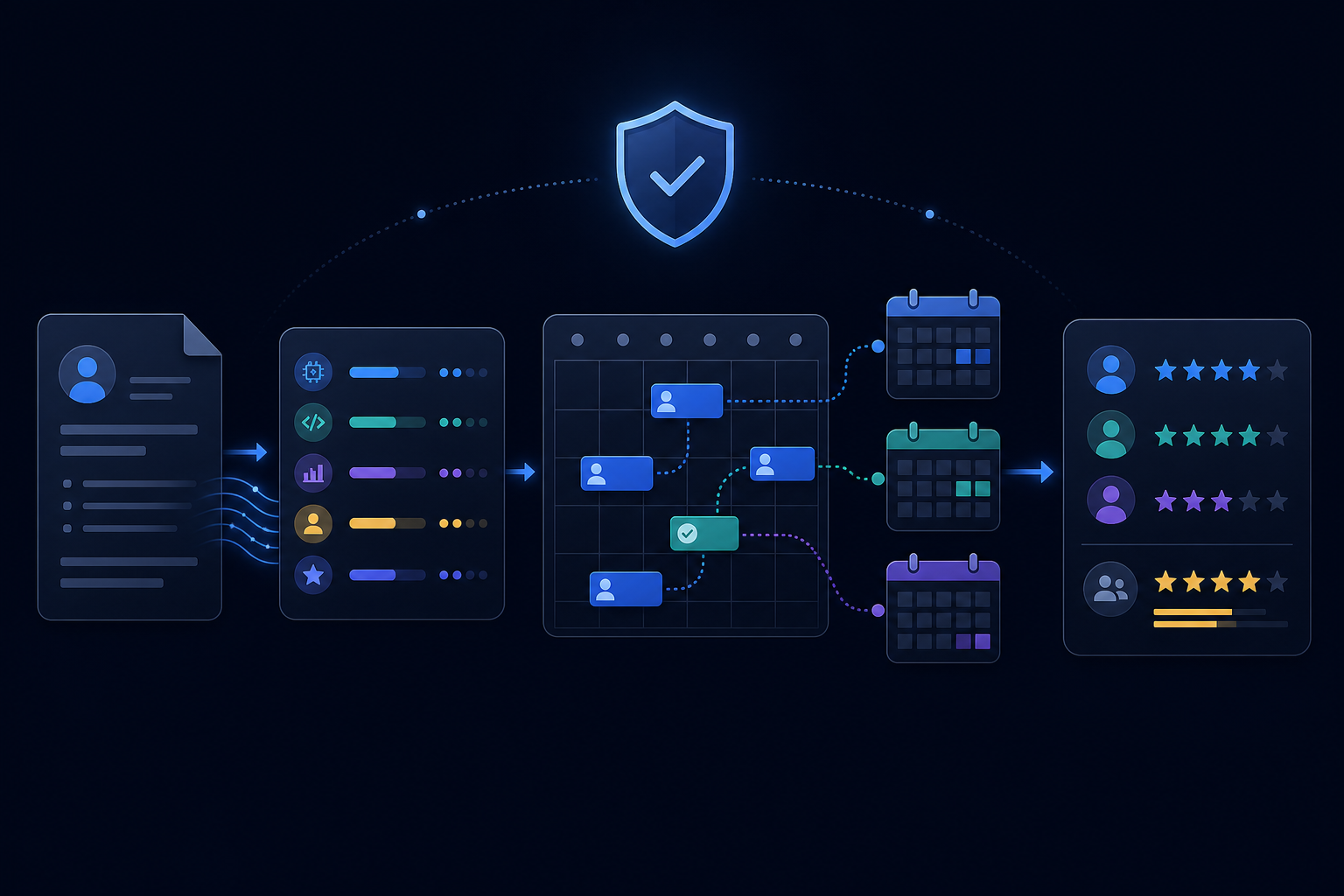
The right approach: build an AI that scores and surfaces candidates for human review, never makes final decisions, and produces structured justifications for its scoring.
The screening step should:
- Extract structured information: work experience, skills, education, relevant keywords from the job description
- Score against specific, defined criteria from the job requirements
- Flag candidates who meet minimum requirements for human review
- Never rank candidates against each other — only score each against the requirements
- Log every screening decision with the inputs and scores for audit
This is an AI-accelerated human process, not an autonomous one.
The scheduling problem
Interview scheduling is coordinative friction at scale. Getting five interviewers, one hiring manager, and one candidate on a call at a time that works for everyone is a genuine optimization problem that consumes enormous recruiter time.
An AI scheduling agent:
- Reads the open time blocks from each interviewer's calendar (via calendar API)
- Identifies overlapping availability windows
- Proposes 3-5 specific times to the candidate via email
- Captures the candidate's selection
- Creates calendar invites for all participants
- Sends confirmation with prep materials
The scheduling agent handles the back-and-forth that consumes most recruiter time. Recruiters handle the relationship work that requires human judgment.
Feedback collection and aggregation
After each interview, the AI workflow sends a structured feedback form to each interviewer, follows up once if not completed within 24 hours, and aggregates the structured feedback into a hiring committee brief.
The aggregation step should present both the individual scores and the areas of agreement and disagreement across interviewers — not a single averaged score that obscures disagreement.
The compliance layer
Every HR AI workflow that touches hiring decisions needs:
- Audit logging: who was screened, with what criteria, producing what score
- Bias monitoring: are candidates with certain demographics being systematically scored differently? This requires demographic data (where legally available) and statistical monitoring
- Human-in-the-loop for all decisions: no AI system makes hire/reject/move-forward decisions autonomously
- Explainability: any candidate who asks why they were not advanced should be able to receive a comprehensible answer
The compliance layer is not optional overhead — it is the thing that makes the system legally deployable and organizationally trustworthy.
AgentRuntime's human task bus handles the interview scheduling confirmation flow natively, and the run state model produces the audit trail that HR compliance requires. Join the waitlist for early access.